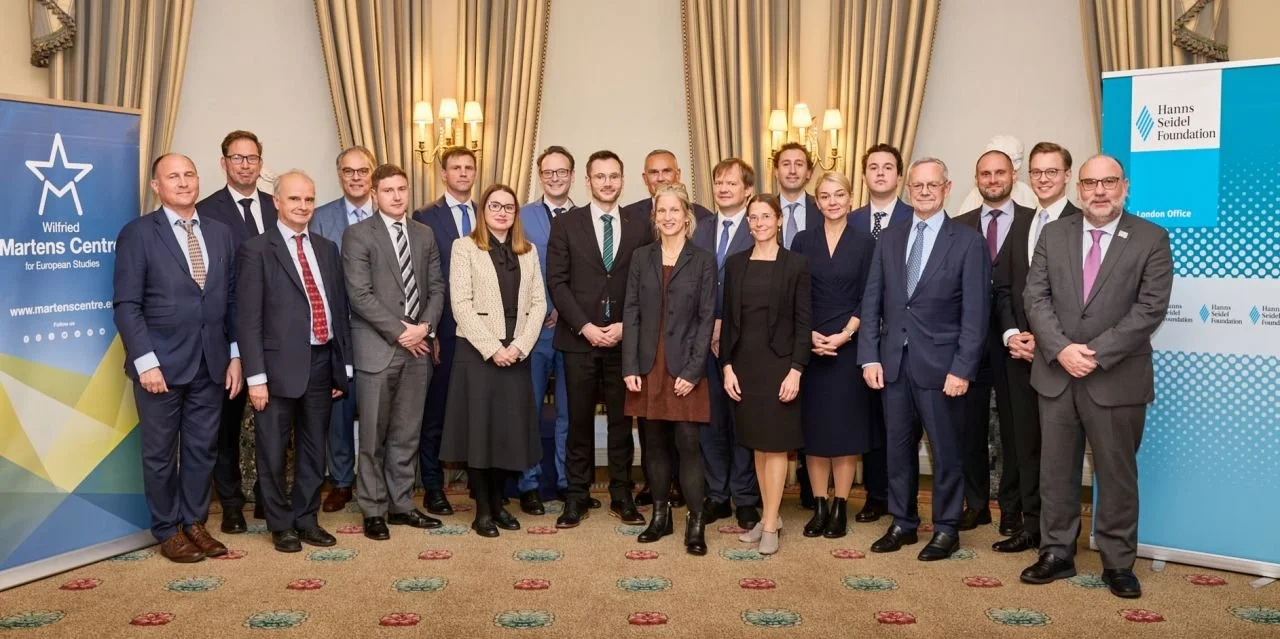
Addressing a closed-door policy workshop convened in London by the Hanns Seidel Foundation UK and the Wilfried Martens Centre for European Studies, St James' Foreign Policy Group CEO Aliona Hlivco joined demographers, military personnel, and policy experts to examine a critical question facing the continent: as European nations rearm, who will actually man the forces?
The two-day session centred on recent research from the University of Oxford and the International Institute for Applied Systems Analysis (IIASA), analysing demographic trajectories across Germany, France, Poland, Spain, and the United Kingdom. While much of the current security debate focuses on defence budgets and material procurement, the workshop underscored that shrinking youth cohorts represent only one facet of a far broader structural challenge.
Social Cohesion and Cognitive Warfare
In her address, Hlivco argued that demographic metrics alone cannot predict military readiness. Whether citizens are eligible, skilled, and willing to serve depends heavily on domestic social cohesion. Public willingness to defend a nation is increasingly shaped by polarisation, social fragmentation, and the digital information ecosystem.
Crucially, hostile foreign actors actively exploit internal societal divides through targeted cognitive warfare. Weakening domestic alignment and eroding trust in public institutions serves as a direct precursor to kinetic conflict. In an era of hybrid threats, sustaining the legitimacy of armed forces across fragmented populations is as crucial as maintaining conventional deterrence.
The Evolving Demands of the Modern Battlefield
The workshop also challenged the assumption that rapid technological advancement simply reduces manpower requirements. While robotics, artificial intelligence, and autonomous systems alter the nature of combat, they elevate rather than diminish the need for highly skilled personnel. Modern militaries find themselves competing directly with the private sector for expertise in software engineering, cybersecurity, AI development, advanced manufacturing, and aerospace.
To build resilient national defence systems, armed forces must offer compelling career pathways that attract top-tier technical talent without relying on the expectation that automated platforms will replace human soldiers entirely. The requirement for professionally trained, dedicated personnel remains indispensable.
Strategic Pathways for Continental Resilience
Overcoming these manpower constraints requires European nations to look beyond traditional recruitment models. Discussions highlighted the need to prioritise personnel retention alongside initial entry, alongside a radical rethinking of reserve structures, flexible service arrangements, and career fluidity between defence, industry, and academia.
As Europe confronts an increasingly volatile security landscape, aligning demographic realities with societal resilience and technological innovation will be essential to building credible, long-term defence capability.