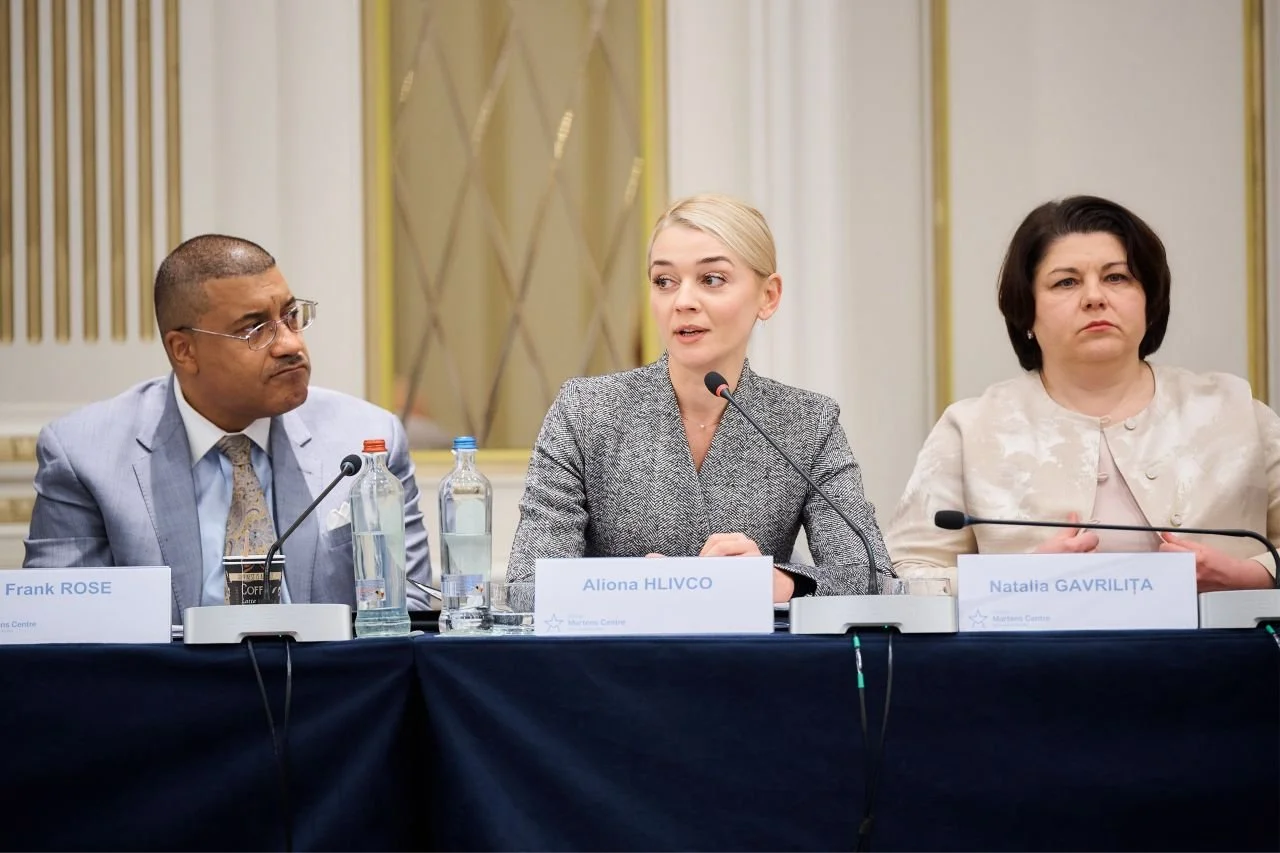
St James' Foreign Policy Group CEO Aliona Hlivco recently participated in the Wilfried Martens Centre for European Studies Academic Council meeting in Brussels, contributing to vital discussions on Europe's emerging security architecture. Since joining the Council, her ongoing research has focused squarely on how Europe can build a credible and self-sufficient deterrence capability by closely partnering with the continent's most innovative and combat-experienced power, Ukraine.
Addressing fellow council members, Aliona emphasised that while Ukraine’s domestic hardware production, spanning aerial, ground, maritime, and subsea drones, indigenous ballistic missiles, advanced electronic warfare, and AI-enabled C4ISR systems, is remarkably agile, the true strategic value lies elsewhere. The decisive edge rests in Ukraine's Tactics, Techniques and Procedures (TTPs). Success in modern high-intensity conflict is defined less by the physical equipment deployed than by how it is operationalised, continuously enhanced, and used to outinnovate the adversary through superior intelligence handling.
At the core of this unmatched capability are the people: the engineers, drone operators, and infantry and artillery officers who combine traditional and novel tools of war every single day. For Aliona, this reality underscores why integrating Ukraine into Europe’s evolving security architecture is an absolute necessity. It is not a question of Ukraine fighting on behalf of Europe, but of fighting alongside it. In an era defined by relentless hybrid attacks and rapid technological disruption, European defence simply does not function without Ukraine.